We will provide the highest standard of professional care in a friendly, welcoming, patient-focused environment
Founded in 1947, Marsden Eye Specialists has been caring for the community for nearly 80 years. We provide comprehensive specialist eye care across Parramatta, Castle Hill and Penrith, supported by our dedicated day surgery in Parramatta. The eye surgeons and surgery staff at Marsden have extensive experience, with over 36,000 operations including 25,000 cataract surgeries having been performed over the last 20 years. We have agreements with major health funds, and are recognised by Department of Veterans Affairs and Medicare.
What we do
Cataracts
Laser Vision Correction
Dry Eyes
Paediatric Eyes
Diabetic Eyes
Glaucoma
Macular Degeneration
Strabismus
Eyelid Surgery
Retinal Surgery
Keratoconous
Corneal Disease
Clinical Trials
Myopia Management
Neurological Eye Conditions
Who works with us
The Marsden Eye Specialists have been providing the highest level of diagnostic, laser and surgical treatment to Western and North-Western Sydney for over 75 years.
Patient Journey
1
Doctor Selection
Referral / Online Research / Second Opinion
2
Consultation
First Visit / Preparation / Conditions
3
Diagnostic
Tests & Measurements
4
Treatment
5
Recovery
Program (Team Effort)
Need more info?
Please visit our First Visit Guide page
Prioritise your vision and eye health
Schedule a consultation with our specialist today!
Resources
Accurate and Clear Information
First Visit Guide
Appointments
Forms & Downloads
For Referrers
What our patients say
Our Locations
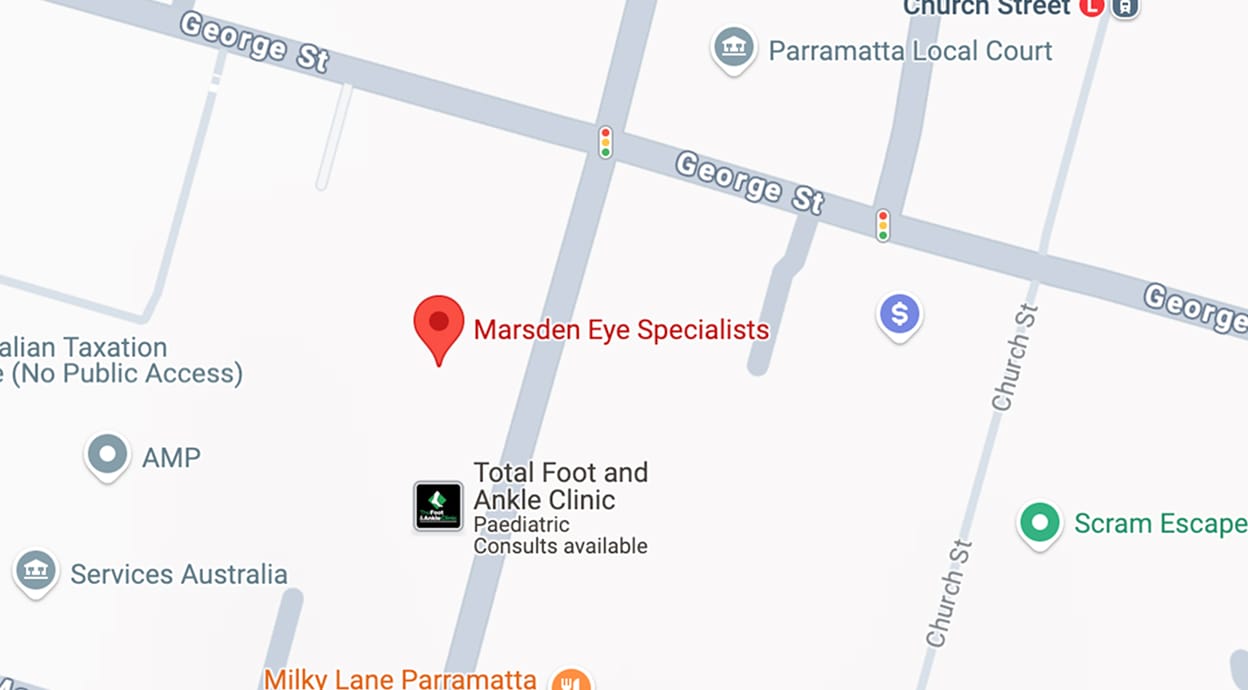
Castle Hill
19/7-9 Barwell Ave
Castle Hill, NSW 2154
(02) 9634 6364
(02) 9894 9094
Mon-Fri 8am to 4.30pm

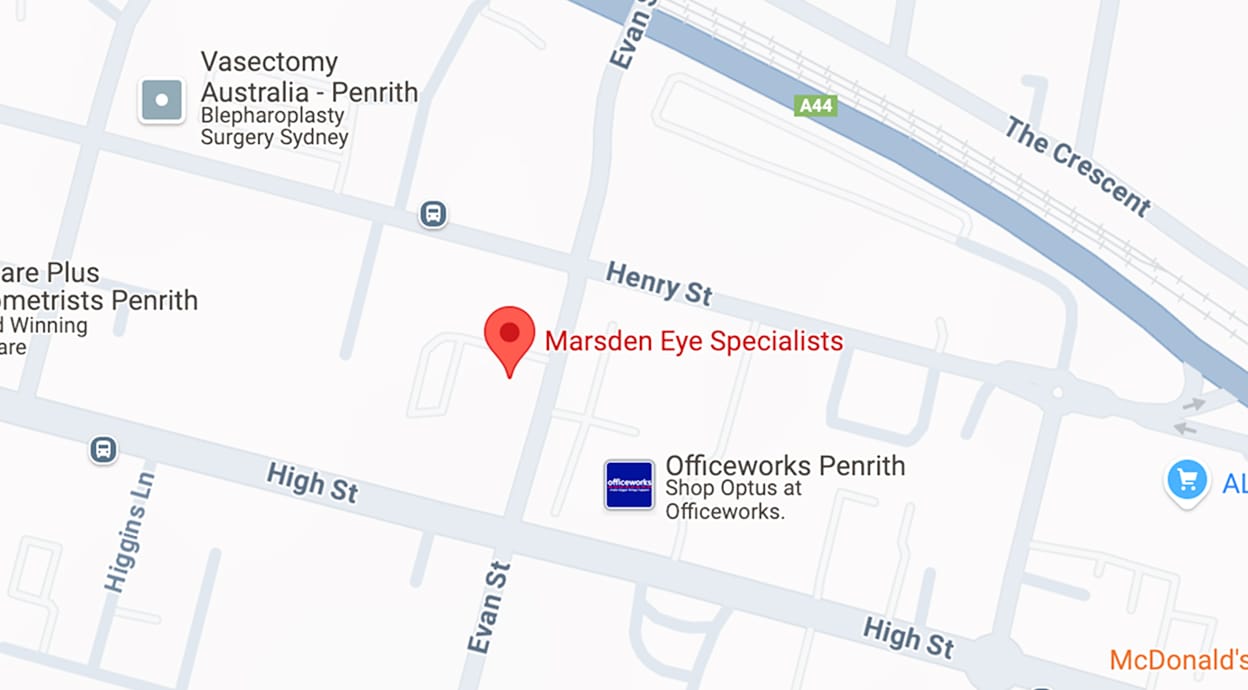
Penrith
295 High Street (Evans Street Entrance)
Penrith, NSW 2750
(02) 4731 1811
(02) 4731 1670
Mon-Fri 8am to 4.30pm
Frequently Asked Questions
This FAQ provides general information only and does not replace advice from your ophthalmologist or other healthcare professional. If you experience a sudden loss of vision, a new curtain or shadow in your vision, severe eye pain, significant eye injury, or sudden flashes and floaters, seek urgent medical attention.
General questions
What services does Marsden Eye Specialists provide?
Our ophthalmologists provide assessment and treatment across many areas of eye care, including cataracts, refractive laser eye surgery, glaucoma, macular degeneration, diabetic eye disease, retinal conditions, corneal disease, dry eye, keratoconus, uveitis, paediatric eye conditions, myopia, strabismus, neurological eye conditions, eyelid and tear-duct disorders, and refractive errors. Explore our services or contact us if you are unsure which service you need.
Which locations can I attend?
We have clinics in Parramatta, Castle Hill and Penrith. Our clinics are open Monday to Friday from 8:00 am to 5:00 pm. Doctor and service availability varies, so please confirm the most suitable location when booking.
Can I request a particular ophthalmologist?
Yes. You may request a particular doctor when booking. Appointment availability and the nature of your eye condition may affect which doctor or location can see you earliest. If you are unsure, our team can guide you.
Can I get a second opinion?
Yes. Marsden Eye Specialists welcomes patients seeking a second opinion. Please bring your referral and any relevant reports, scans, test results and previous treatment information.
What should I do if I need urgent eye care?
Please call the clinic and explain your symptoms so our team can advise you. Do not use an online enquiry for an eye emergency. Sudden loss of vision, a curtain or shadow in your vision, severe eye pain, significant trauma, or sudden flashes and floaters may require urgent assessment. If you cannot reach us or it is outside clinic hours, contact your GP, attend the nearest emergency department or call Triple Zero (000) for a life-threatening emergency.
Do you provide interpreter assistance or accessible care?
Please tell our team about any language, mobility, hearing, vision or other accessibility needs when booking. We will discuss the available arrangements and how best to support your visit.
Bookings and referrals
Do I need a referral to see an ophthalmologist?
You can contact us to discuss an appointment. However, a current referral from a GP, optometrist or another specialist is generally required to claim the applicable Medicare rebate for a specialist consultation. Please bring your referral to your appointment. A referral is not required for our free laser vision correction assessment.
How do I book an appointment?
You can submit an appointment request through our online booking form or contact the clinic you would like to attend. Our team will help arrange an appointment with an ophthalmologist whose area of expertise suits your needs.
How do I cancel or reschedule my appointment?
Please contact the clinic as early as possible if you cannot attend. This allows us to offer the appointment to another patient and arrange a new time for you.
Appointments and preparing for your visit
What should I bring to my first appointment?
Please bring:
- your current referral
- your Medicare card and any pension or healthcare card
- a list of your current medications and allergies
- relevant clinical letters, scans, test results or imaging
- your current glasses for distance, driving or reading
- your completed new-patient information form, if available.
See our First Visit Guide for more information.
How long should I allow for my appointment?
Please allow approximately two to three hours for a comprehensive appointment. Your visit may include screening by an orthoptist, diagnostic testing, pupil dilation and consultation with your ophthalmologist. Complex conditions or unexpected clinical needs can sometimes extend waiting times.
Why do I see an orthoptist before the ophthalmologist?
Orthoptists are university-trained eye healthcare professionals. They assess your vision, take a relevant medical and eye history, and perform measurements or diagnostic tests to prepare you for the ophthalmologist's examination. This team-based approach helps the doctor assess your condition thoroughly.
Will I need extra tests?
Your care team may recommend tests such as optical coherence tomography (OCT), visual-field testing, retinal photography, cataract measurements or corneal topography. The tests required depend on your condition. You will be advised of the purpose and cost of additional testing before it is performed.
Will my pupils be dilated?
Dilating your pupils with eye drops may be needed to examine the inside of your eyes. Dilation can cause blurred vision and sensitivity to light for several hours. Bring sunglasses and consider arranging for someone to accompany you.
Can I drive after my appointment?
We do not recommend driving after pupil dilation because your vision may be temporarily blurred and sensitive to light. If dilation may be required, arrange alternative transport or bring someone who can drive you home.
Can a family member or support person attend with me?
Yes. You are welcome to bring a family member, carer or support person. This can be particularly helpful if your eyes are dilated, you are discussing surgery or you would like assistance understanding or remembering information.
Fees, Medicare and billing
What will my appointment cost?
Fees vary according to the doctor, type of consultation and any diagnostic tests required. Please contact the clinic for an estimate. If additional testing is recommended during your visit, you will be advised of the cost before it is performed.
Can I claim a Medicare rebate?
Eligible specialist consultations and some tests or treatments may attract a Medicare rebate when you have a valid referral and meet Medicare requirements. Your out-of-pocket cost will depend on the services provided and your individual circumstances. Our reception team can explain the fees and can claim the Medicare rebate for you.
Do you offer pension rates or support for patients experiencing financial difficulty?
Pension rates are available for eligible patients. Some patients may also be eligible for the Medicare Safety Net, selected clinical trials or other arrangements. Please discuss financial concerns with our team when booking or ask your referrer to note them in the referral so available options can be considered.
What payment methods do you accept?
Marsden Eye Specialists accepts EFTPOS, Visa, Mastercard, cash and cheque. Payment is generally made after your consultation.
Will private health insurance cover my appointment or surgery?
Private health insurance generally does not cover outpatient specialist consultations, although Medicare rebates may apply with a valid referral. Hospital or day-surgery cover varies by policy, procedure and insurer. Before surgery, you will receive financial information and should confirm your level of cover and any excess or co-payment directly with your health fund.
Laser Vision Correction FAQS
Am I suitable for Laser Vision Correction Surgery?
To determine your suitability for laser vision correction, you will require a thorough eye examination. At the Marsden Eye Laser Clinic we invite you to take advantage of our complimentary consultation where one of our Refractive Orthoptists will perform all relevant tests and discuss the best and safest surgery for your eyes.
For the complimentary consultation do I need a referral?
No referral is required for the initial complimentary consultation.
How long does the laser surgery take?
You may be required to spend about 1.5 hours at our day surgery although the laser procedure itself will take approximately 20 minutes to perform both eyes. Pre-operative administration and preparation takes about 20 minutes. After your laser procedure, you will be offered tea or coffee and rest for about 10 minutes.
Am I awake during the laser surgery?
The procedure is done under local anaesthetic in the form of an eye drop. You will be awake for the procedure, this allows you to focus on a light which helps to centre and align your vision with the laser for better tracking and treatment outcome.
Is laser surgery painful?
You will be given local anaesthetic eye drops which will numb your eyes so you will not experience any pain during the procedure. You can also be given an optional mild sedative tablet to help make you feel at ease.
When will I see again after laser surgery?
Initially after the surgery your vision will be blurred as though looking through frosted glass, although you should be able to see through the blur.
Visual recovery is very quick and depends on the type of laser procedure performed.
LASIK & SMILE – usually within 24 hours your vision will have mostly recovered.
PRK – usually by day 4-5 your vision will have mostly recovered.
How much time will I need off work?
Recovery time is approximately 24 hours, depending on the type of laser surgery performed. We recommend you take the day of your procedure and the following day off work and resume to normal work duties by the 3rd day.
Is the laser surgery permanent?
Yes, all types of laser vision correction surgery will permanently change the shape of the cornea. Usually, if you are over 20 years of age and have had a stable prescription for 12 months, your eyes will not change and the surgery will be permanent. The surgery will not halt the natural progression of the eye. Presbyopia develops around the age of 40-45 years of age and this can reduce the ability to focus on close objects. This will occur natural regardless of having laser vision correction or not. If you can have laser vision correction surgery to delay the need for near glasses or to correct this.
What's the next step?
Laser vision correction is a life-changing decision. The team at Marsden Eye Laser Clinic is dedicated to ensuring you are fully informed at every stage of your journey. Contact us today to book your complimentary suitability assessment and consultation.
Phone: (02) 9635 6964
Mobile: 0417 635 400
Email: lasik@marsdeneye.com
Cataract FAQs
What is a Cataract?
A cataract is one of the most common eye conditions and causes blurry vision due to clouding of the natural lens in the eye. The human lens is located behind the iris (the coloured portion of the eye), and it is mostly made up of water and proteins. When a cataract occurs, the lens becomes cloudy and is seen as a white cloudy ball in the centre of the iris.
Who is at Risk of Cataracts?
- The development of a cataract can occur with the natural aging process of an individual.
- Cataracts can also be inherited or can develop in infants as a result of infections in the mother during pregnancy.
- They can form as a complication of other diseases such as glaucoma and diabetes, or can develop after certain injuries.
- Prolonged use of corticosteroid inhalers and eye drops, and excessive exposure to UV rays, X-rays and other radiation during radiotherapy, can increase the risk of cataract formation.
What Are the Symptoms of Cataracts?
Symptoms commonly associated with cataracts include:
- Blurry or cloudy vision
- Faded colours
- Increased glare from lights
- Poor vision at night
- Multiple images
- Frequent change in eye prescription
What are the consequences of leaving cataracts untreated?
Cataracts do not heal on their own or with conservative treatment. Vision loss will only get worse and will lead to blindness if not treated by surgery.
How to prepare for Cataract surgery?
Before surgery, you may be asked to fast 12 hours before the procedure. Your anaesthetist will perform a medical assessment and provide you with sedation and an eye block (numbing procedure) as required. You will not be able to drive after the procedure, so you should have someone ready to take you home. You may also have to arrange for home assistance.
What is involved in the Cataract surgery?
Cataract Surgery is performed in five stages, these are:
- The operated eye will be anaesthetised by a specialist Anaesthetist.
- A small incision will then be created to allow access to the cataract.
- The cataract will be broken into small pieces with an ultrasound probe (phacoemulsification) and removed.
- After the cataract is removed, an artificial lens implant will be inserted into the eye for focusing light
- The eye will be covered and you will be given refreshments before being accompanied home by your family member or carer.
What types of lens implants (Intraocular lenses) are available?
An intraocular lens is an artificial lens that is used to replace your natural lens. It allows light to focus on the retina and provides clear vision in place of your natural lens. They are used in cataract surgery and refractive lens exchange surgery. Marsden Eye Specialists uses a wide range of premium intraocular lenses, including multifocal, toric, monovision and extended depth of focus lenses to provide you, with the best possible vision, decreasing your dependence on glasses and tailored to your individual eyes and lifestyle.
What's the next step?
Deciding to proceed with cataract surgery is an important medical choice. We recommend scheduling a comprehensive consultation with one of our Ophthalmologist. During this visit, we will thoroughly review your individual surgical options and discuss the relative benefits and considerations of each intraocular lens type.Our team will guide you through selecting the optimal lens to match your specific ocular anatomy, visual needs, and lifestyle objectives.
To arrange your consultation, please contact our practice:
- Phone: 02 9635 7077
- Email: enquiry@marsdeneye.com
Glaucoma
What treatments are available for glaucoma?
Glaucoma management is tailored to the individual and may include monitoring, prescription eye drops, laser treatment or surgery. The aim is usually to lower eye pressure and protect the optic nerve from further damage. Your ophthalmologist will recommend an approach based on your glaucoma type, severity, general health and response to treatment. Learn more about glaucoma treatment.
Retinal and macular conditions
Do you treat macular degeneration and other retinal diseases?
Yes. Our medical and surgical retinal services assess and manage conditions including age-related macular degeneration, diabetic retinopathy, retinal vein occlusion, retinal tears and retinal detachment. Depending on the condition, treatment may include monitoring, intravitreal injections, retinal laser, photodynamic therapy or retinal surgery. Learn more about retinal disease treatment.
Corneal conditions and dry eye
Do you offer treatment for dry eye and corneal conditions?
Yes. We assess and manage dry eye, keratoconus, pterygium, corneal dystrophies and other corneal conditions. Treatment depends on the cause and severity and may include lubricating or prescription eye drops, in-clinic therapies, corneal cross-linking or surgery. A consultation and appropriate testing are needed to recommend a treatment plan.
Children, myopia and strabismus
Do you see children?
Yes. Marsden Eye Specialists assesses children with conditions such as reduced vision, amblyopia (lazy eye), strabismus (squint), focusing problems and other paediatric eye concerns. When booking, provide your child's age and the reason for referral so the appropriate appointment can be arranged.
Do you offer myopia management for children and teenagers?
Yes. Our myopia clinic provides assessment and ongoing monitoring. Management is individualised and may include low-dose atropine, red light therapy or other evidence-based options.
Oculoplastics
Do you perform eyelid, tear-duct and orbital surgery?
Yes. Our oculoplastic service assesses and treats eyelid, lacrimal (tear-duct) and orbital conditions. Treatment may be medical or surgical depending on the diagnosis and your needs.
Double Vision & Neurological eye conditions
Do you manage double vision, strabismus and neurological eye conditions?
Yes. Our ophthalmologists and orthoptists assess eye-movement disorders, double vision, strabismus and vision problems related to the nervous system. Management may include observation, prisms, exercises in selected cases, injections, treatment of the underlying condition or surgery.
Surgery and aftercare
Where is eye surgery performed?
Many procedures are performed at Marsden Eye Day Surgery in Parramatta, while some treatments may be undertaken in the clinic or at another facility. Your surgeon and booking team will confirm the location, arrival time and preparation instructions for your procedure.
What happens after my ophthalmologist recommends surgery?
Your surgeon will explain the recommended procedure, alternatives, expected benefits, limitations and risks, and obtain informed consent. The bookings team will then help arrange a date, complete the administrative requirements, provide pre-operative instructions and give you financial information.
Will I need someone to take me home after surgery?
Yes. You should arrange for a responsible adult to take you home after eye surgery. Depending on the procedure and anaesthetic, you may also need someone to stay with you or assist you for a period after discharge. Follow the specific instructions provided by your surgical team.
How long will recovery take?
Recovery varies according to the procedure, your eye health and the type of work or activities you do. Your surgical team will explain when you can return to driving, work, exercise, swimming and other activities. Attend all follow-up appointments and use prescribed medications exactly as directed.
What should I do if I have concerns after surgery or treatment?
Follow the post-operative instructions provided by your surgical team and use the contact number on your discharge information. Contact us promptly if you develop increasing pain, worsening redness, discharge, a sudden reduction in vision or another symptom identified in your instructions. For a severe or life-threatening emergency, call Triple Zero (000) or attend the nearest emergency department.
Clinical trials
Does Marsden Eye Specialists conduct clinical trials?
Yes. Marsden Eye Research Centre participates in local and international clinical trials involving conditions such as age-related macular degeneration, diabetic macular oedema, retinal vein occlusion and glaucoma. Eligibility depends on each study's criteria, and participation is voluntary. Ask your ophthalmologist or visit the Research Centre to learn more.
Medical records and communication
How can I request my medical records?
You can select “Request Records” on our general enquiry form or contact the clinic. To protect your privacy, we may need to verify your identity and obtain written authority before releasing information. Processing time may apply depending on the request.
Can my results be sent to my GP or optometrist?
Yes. With your consent and appropriate contact details, relevant correspondence can be sent to your referrer or other healthcare professionals involved in your care. Please confirm their details with reception.
Locations, parking and contact details
How can I contact Marsden Eye Specialists?
- Parramatta: (02) 9635 7077 — 152 Marsden Street, Parramatta NSW 2150
- Castle Hill: (02) 9634 6364 — Suite 19, 7–9 Barwell Avenue, Castle Hill NSW 2154
- Penrith: (02) 4731 1811 — 295 High Street, Penrith NSW 2750 (Evans Street entrance)
- General enquiries: enquiry@marsdeneye.com
All three clinics are open Monday to Friday, 8:00 am to 5:00 pm. Please check the relevant location page for current parking and public-transport information before your visit.


